Long Island, 1962 Ash Wednesday Storm
South shore after the March 1962 northeaster · 90 frames · select a photo to view and zoom.
About these photographs
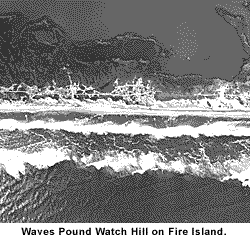
This remarkable Northeaster was also known as "Five High" storm because it lingered off the Atlantic Coast of the northeast United States over a period of five high tides, thereby intensifying the effects of high wave energy on the coast. This powerful storm claimed 33 lives and caused great property damage in Delaware, New Jersey, and New York. In Long Island, peak storm-tide elevations were . 4.0 ft at Swan R. at East Patchogue and at Connetquot R. near North Great River, 7.1 ft NGVD at the Battery (Manhattan Island).
The storm was responsible for over 75 breaks (washovers) between Fire Island Inlet and Southampton. The largest breach, about 400 m wide, was at Westhampton Beach. In the Moriches to Shinnecock Reach, large stretches of Dune Road and 46 houses were destroyed. Notable offset at Shinnecock Inlet: west side eroded, accretion along east side. President Eisenhower declared the south shore a disaster area eligible for Federal aid. Under authority of Public Law 875, 81st Congress, the U.S. Army Corps of Engineers performed engineering and construction of emergency shore protection and rehabilitation. Some 2,210,000 yd3 of sand was pumped onto beaches, mostly from back bays.


